Power Generation: Keeping an Aging Industry Ready for Tomorrow’s Energy Demands
This is Part 4 of our ongoing series, “How 3D Scanning and Reverse Engineering Address Emerging Challenges in Industry and Technology.”
“The development and wealth of a city, the success of a nation, the progress of the whole human race, is regulated by the power available.”
A warning from a modern-day government official, perhaps the Secretary of Energy, about the need to modernize our nation’s electrical infrastructure? No. The statement actually comes from Nikola Tesla in 1900. More than a century later, his prescient observation remains remarkably relevant. Tesla recognized that access to abundant electricity was essential to a nation’s industrial progress and prosperity. Today, as society’s dependence on electricity continues to grow, so too does the importance of maintaining, modernizing, and expanding the systems that generate and deliver it. Meeting today’s demands—and those of the future—requires power generation and delivery capabilities that are not only greater in capacity, but also more efficient, reliable, and resilient.
Those are just some of the challenges facing today’s power generation industry. (Other challenges will be explored in future installments of this series.) While demand for electricity is growing, generating facilities are under increasing pressure to operate at peak performance, and energy producers are working to modernize existing infrastructure by incorporating new technologies. At the same time, many power plants rely on aging equipment that can be difficult and costly to maintain or replace.
No matter how a facility generates electricity, whether by using coal, natural gas, nuclear power, hydroelectric systems, or other energy sources, keeping its equipment operational and efficient is essential.
Addressing these challenges—keeping existing equipment operational, adapting it to new requirements and technologies, and improving its performance—often requires more than conventional inspection and measurement methods. Engineers need detailed, accurate information about the actual dimensions, geometry, and condition of existing equipment. This can be particularly challenging when original engineering drawings are unavailable or no longer reflect the equipment’s current configuration.
This is where 3D scanning and reverse engineering can make a significant difference.
Challenge 1: Keeping Aging Infrastructure and Equipment Operational
Why It’s Emerging
Much of the current power generation infrastructure was designed and built decades ago. Although many facilities have undergone upgrades over the years, they often still depend on original turbines, generators, pumps, piping systems, and other critical equipment.
As these legacy components age, maintaining them becomes increasingly difficult. Years of operation can cause parts to wear, deform, or sustain damage. Replacement components can be difficult to obtain, particularly when the original equipment manufacturer (OEM) has discontinued a product or gone out of business. Even when original engineering drawings are available, they may not provide everything needed to successfully reproduce a replacement part. Over time, drawings can become outdated, lack critical details, or fail to reflect the component’s current, “as-is” dimensions (its current condition after years of service, as opposed to its original “as-built” state) and configuration.
To avoid the high cost of custom-engineered parts or a complete system overhaul, some plant operators even turn to eBay and specialized online marketplaces to hunt down discontinued components for legacy systems.
When a discontinued or hard-to-find original part needs to be replaced and its design documentation is missing, the physical component itself may become the most important reference for recreating it.
How 3D Scanning Helps
Because replacing an entire assembly isn’t always practical or economically feasible, power plant operators often need to refurbish existing components, reproduce obsolete parts, or develop replacement designs that will fit and function within the original equipment. Non-contact 3D scanning provides a streamlined, efficient way to capture the precise geometry of existing equipment of all sizes, including components with complex surfaces and contours that are difficult to measure using conventional tools.
Capturing critical dimensions and surface geometry at high levels of accuracy makes it possible to create digital models that manufacturers and engineers can use to reproduce existing parts or develop redesigned components.
For example, turbine blades, impellers, diaphragms, casings, and other critical components can be scanned to create highly accurate digital representations. This dimensional data can then be used to generate computer-aided design (CAD) models for reverse engineering. Engineers can analyze, modify, or use the models as the basis for manufacturing replacement parts.
Reverse engineering also makes it possible to recreate components for which no usable drawings or CAD files exist. Engineers can work from the actual physical part rather than relying on potentially inaccurate historical documentation.
The result is a more reliable foundation for equipment refurbishment, replacement-part manufacturing, and continued maintenance of aging power generation assets.
Challenge 2: Modernizing Existing Plants to Accommodate New Technologies
Why It’s Emerging
The energy industry is undergoing a period of significant change. Power producers are upgrading existing facilities, incorporating newer technologies, and, in some cases, converting plants to different energy sources or operating configurations.
Modernizing a legacy facility presents challenges that are considerably different from designing a new plant. Instead of designing around new technology, teams must adapt new technology to fit what is already there.
To accomplish this, engineers frequently have to retrofit facilities, incorporating new equipment, sensors, instrumentation, and control systems into machinery and structures that were never designed to accommodate them. This can present a host of hurdles: space may be limited, existing components may have to remain in place, current plant configurations may have interference issues, and even relatively small modifications can create unexpected installation problems.
For example, converting an older facility to a combined-cycle natural gas system is a massive undertaking. It may require modifications to original turbine assemblies, including the installation of new sensors and emissions controls. Determining where these components can be installed without interfering with surrounding structures or equipment is an important part of the engineering process. Relying on outdated blueprints or manual measurements can easily stall a project. Accurate 3D scan data and reverse-engineered models can help engineers assess existing conditions and plan modifications before installation begins.
Case in point: At a southeastern power plant making the switch to natural gas, NVision used 3D laser scanning and reverse engineering to assist with the upgrade and help reduce project costs and delays. The overall conversion ultimately increased power output by nearly 35% and reduced CO₂ emissions by roughly 50%.
To make room for new sensors and emissions controls inside the existing turbomachinery, NVision’s engineers scanned the plant’s turbine covers, housings, shafts, and vanes in just three days using a combination of large-area scanners, handheld scanners, and laser trackers. They then transformed the scan data into a coordinated 3D CAD assembly using Siemens NX, along with IGES and STEP files for broader engineering compatibility. This gave the plant’s engineering team an accurate digital model of the existing equipment to help map out sensor paths and evaluate design modifications, reducing uncertainty during the modernization process.
By capturing accurate measurements upfront, NVision helped the facility avoid costly engineering rework and installation errors, saving over $250,000 in the process.
How 3D Scanning Helps
Before undertaking modifications, engineers need an accurate understanding of the equipment and surrounding structures as they actually exist. 3D scanning can capture the geometry of large assemblies, internal cavities, housings, piping systems, and individual components. Engineers can then use the resulting data to create detailed 3D CAD models of the existing equipment.
These digital models provide a virtual environment in which engineers can view and evaluate proposed modifications, determine optimal locations for new components, identify potential interferences, and plan installation procedures—all before work begins.
This can help reduce the need for repeated measurements, physical trial-and-error fitting, costly engineering rework, and downtime.
In addition, scanning can help ensure that replacement or redesigned components are compatible with existing equipment, even when the original design documentation is incomplete.
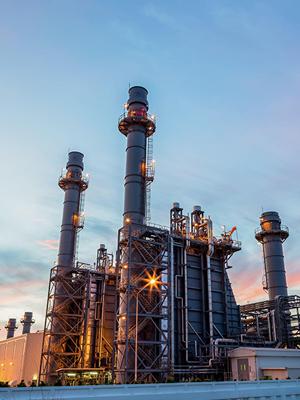
Turbine and Generator in a Natural Gas power plant
Challenge 3: Increasing Generating Capacity, Efficiency, and Reliability
Why It’s Emerging
As electricity demand increases, power producers face growing pressure to get more performance out of their existing generating assets. At the same time, they also need to control operating costs, minimize unplanned outages, and maintain equipment reliability.
These multiple objectives can be difficult to achieve when machinery has experienced years of wear or when existing components have changed dimensionally over time. Even relatively small dimensional deviations in critical components can affect equipment performance.
It’s a bit like a jigsaw puzzle: a slight distortion in one piece can prevent the entire assembly from fitting together as intended.
Turbine blade geometry, for example, plays an important role in how efficiently a turbine operates. Over time, wear can increase the critical clearances between rotating blade tips and the stationary casing, allowing more gas to bypass the blades and potentially reducing turbine efficiency. Similarly, wear or dimensional changes in impellers, pumps, and other rotating equipment can affect performance and reliability.
The ability to identify these deviations and determine whether components should be repaired, replaced, or redesigned can be a significant step toward improving overall plant performance.
How 3D Scanning Helps
Whether a component is newly manufactured (“as-built”) or has experienced decades of field wear and modification (“as-is”), 3D scanning and reverse engineering accurately capture its exact physical dimensions. High-accuracy 3D scanning allows engineers to capture the actual “as-is” geometry of components and compare it with original CAD models, design specifications, or other reference data. Even when no reference data is available, scanning provides a precise baseline model that engineers can analyze for symmetry, structural distortion, and wear patterns—or use to establish a new digital benchmark for future inspections.
This makes it possible to identify dimensional deviations and document surface wear or visible damage. Engineers can use these findings to determine whether components meet dimensional requirements and whether further inspection or corrective work may be necessary. They can also use the resulting digital models to evaluate potential design improvements and develop more effective refurbishment or replacement strategies.
When dimensional inspection reveals signs of severe wear, distortion, or potential material fatigue, NVision can also complement its 3D scanning with metallurgical testing and analysis—helping engineers evaluate structural integrity, investigate possible causes of failure, and assess whether a component may be suitable for refurbishment.
Metallurgical analysis can also help characterize alloy composition and heat-treatment condition and identify material-related issues that dimensional measurements alone cannot reveal. This additional information can help engineers make better-informed decisions about repairs and replacement components.
Scanning can be particularly valuable when inspecting complex components such as turbine blades, where capturing the complete surface geometry with conventional measurement tools can be time-consuming and difficult.
Beyond individual components, scanning larger assemblies and facility layouts can help engineers evaluate equipment relationships, plan maintenance activities, and identify opportunities for improving existing systems.
By providing accurate dimensional information, 3D scanning gives power plant engineers a better basis for making decisions that can help improve equipment reliability, reduce downtime, and optimize generating performance.
A More Accurate Picture of Power Generation’s Future
The power generation industry’s challenges aren’t going away. Aging infrastructure, changing energy requirements, and the need for greater efficiency will continue to place demands on plant operators and engineering teams.
Meeting these challenges requires accurate information about the equipment and facilities that generate our electricity. Whether the objective is to reproduce an obsolete component, modernize an existing turbine assembly, support a transition to alternative fuels, or identify opportunities to improve equipment performance, 3D scanning and reverse engineering can provide the dimensional data and engineering insight needed to accelerate project timelines.
With more than three decades of experience serving the power generation industry, NVision provides non-contact optical scanning, reverse engineering, and CAD modeling services for everything from individual turbine blades and impellers to complete turbine assemblies and complex facility piping systems. By combining high-precision scanning and CAD modeling with metallurgical testing and analysis, NVision can provide a range of complementary services to support power generation engineering projects.
In an industry where any downtime can be extremely costly, having accurate digital information on equipment can mean the difference between a lengthy, complicated engineering project and a more streamlined, predictable solution.
This article began with a quote from Tesla. We’ll end it with a quote from his erstwhile employee and rival, Thomas Edison: “There’s a way to do it better—find it.”
For today’s power generation engineers, 3D scanning and reverse engineering provide that better way—turning physical equipment into the precise digital insight needed to keep critical infrastructure running stronger and longer.
About NVision
NVision’s 3D scanning and reverse engineering services can help provide the dimensional data and digital models engineers need to tackle these challenges—from documenting existing components to developing CAD models and supporting the design of replacement parts.
Let’s Connect!
Have an emerging power generation challenge that could benefit from 3D scanning? NVision can help explore the possibilities.