NVision's 3D Scanning Expertise Accelerates Breast Implant and ENT Device Design
How Two Surgical-Product Innovators Solved Design Bottlenecks—and Accelerated Their R&D Timelines
In the world of medical device manufacturing, design delays don’t just slow down business—they can postpone critical improvements in patient care. The consequences aren’t merely financial; even minor setbacks carry a very real human toll.
Two prominent surgical-product developers recently found their efforts to redesign products stalled by missing or incomplete computer-aided design (CAD) data for essential components. A CAD model created from this data—a digital representation of a device, part, or production component—is essential for medical manufacturers, as CAD models:
- Enable digital simulation of the working product, rapid exploration of alternate designs, and virtual testing before physical prototyping.
- Ensure precise dimensional control and compliance with regulatory standards, facilitating smoother approval processes.
- Streamline production and aid in future redesigns.
- Advance the efficient design of packaging solutions that protect the product and optimize space for shipping.
For these two medical manufacturers, manually re-engineering the parts would have added weeks—or even months—to their development timelines. Both companies turned to NVision for a fast, precise, engineering-grade digital solution to accelerate future design work.
Case 1: Breast Implant Developer Recreates Complex Mandrels Without Original CAD Files
Context & Challenge
A major manufacturer of breast implants faced a significant development challenge: the company no longer had computer-aided design (CAD) files for a full series of implant mandrels—10 shapes ranging from round profiles to complex teardrop geometries. Breast mandrels (the molds used to shape implants) are not only for cosmetic augmentation; they are critical in reconstructing breasts after mastectomies, trauma, or congenital deformities. Important in tissue engineering, reconstructive procedures, and quality-of-life restoration, mandrels can be a key part of comprehensive cancer care.
Without accurate digital models of the mandrels, recreating or redesigning implants—or scaling manufacturing for new product lines—was nearly impossible. The stakes were clear: the manufacturer faced stalled R&D, disrupted production, and costly delays in bringing improved products to surgeons and patients.
Solution & Process
The manufacturer contacted NVision and sent the 10 existing mandrels, each with a different shape and size. NVision engineers set to work digitizing the full geometry of each mandrel. NVision’s HandHeld 3D laser scanner—capable of capturing 60,000+ measurements per second with ±0.001-inch accuracy (about one-third the width of an average human hair)—was selected for the project due to the mandrels’ highly complex curvatures.
“The HandHeld Scanner is highly versatile and can obtain the precise dimensions of objects of almost any size or shape, making it ideally suited for this type of application.”
— Steve Kersen, President of NVision
NVision engineers scanned each mandrel in about 30 minutes, then blended multiple surface types and curvature transitions into clean, “watertight” CAD models ready for engineering, manufacturing, or analysis. Despite the mandrels’ highly complex curved geometries, the team balanced absolute dimensional accuracy with the smooth surface blending required for implant tooling.
During scanning, the complexity of the mandrels’ surfaces—which ranged from a teardrop shape to a round contour and beyond—required NVision engineers to “fit together,” or blend, surfaces of very different shapes and planar directions in order to create accurate 3D CAD models.
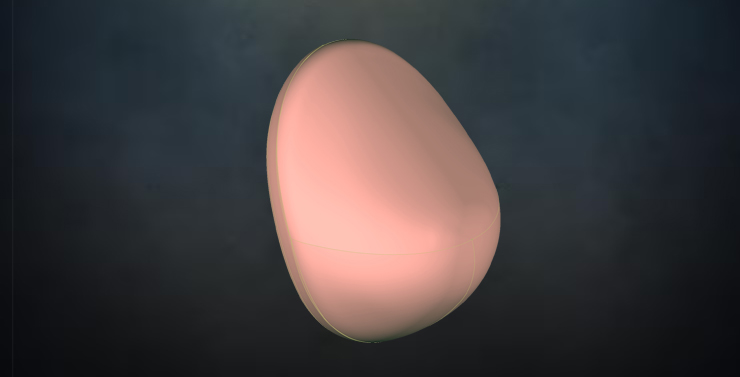
Rendered CAD image of scanned mandrel.
Outcome
Within 10 days, the manufacturer received complete, fully parametric 3D CAD models for all 10 mandrels—restoring digital design control and enabling next-generation implant development.
Measured Results
- An estimated 80% savings in redesign time compared with manual measurement.
- Zero dimensional gaps in the CAD models, allowing immediate integration into the manufacturer’s CAD/CAM workflow.
- Full restoration of production capability for the mandrels.
Case 2: ENT Surgical Device Maker Accelerates New Product Development With Accurate 3D Model of Multidebrider
Context & Challenge
A manufacturer of ear, nose, and throat (ENT) surgical tools was developing a new positioning device for its multidebrider—a rotary cutting instrument used in minimally invasive procedures. A multidebrider removes (and then suctions out) unwanted tissue and foreign matter from the patient’s head and neck areas, including the sinuses and nasal passages. The device generally consists of a rotating tube configuration mounted on a handpiece the physician uses to control the cutting tube.
However, the original device lacked a detailed 3D CAD file. Without an accurate digital model, designing the new positioning accessory would have been difficult, time-consuming, and potentially error-prone.
Solution & Process
After reviewing several vendors, the company chose NVision based on its 35-year history of engineering expertise and professionalism.
“We needed a precise CAD file of our existing multidebrider before we could design the new positioning device. NVision understood that immediately and took ownership of the process.”
— Project Lead, ENT Device Manufacturer
NVision scanned the multidebrider—from the distal tip of the cutting tube to the handpiece—using the same high-resolution HandHeld scanner. The full scan took about one hour, after which engineers created a complete 3D CAD model for the client’s design team.
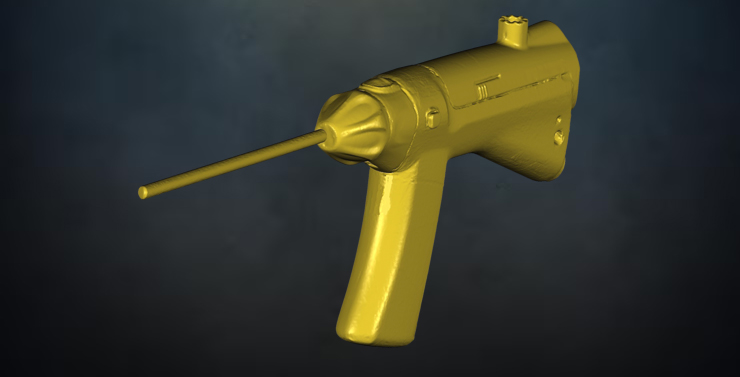
After receiving the multidebrider, NVision scanned it in its entirety in about one hour
Outcome
The manufacturer received a production-ready 3D CAD file that became the foundation for its new positioning device.
Measured Results
● Roughly 70% faster early-stage design work.
● Significant reduction in prototyping errors due to precise geometry.
● Accelerated path to clinical introduction, improving surgical efficiency and safety for ENT patients.
“Without the accurate CAD template, designing the new positioning device would have been far more difficult and expensive.”
— Project Lead, ENT Device Manufacturer
Conclusion: Engineering-Grade Accuracy That Moves Innovation Forward
For both manufacturers, NVision’s combination of high-precision scanning and advanced CAD modeling provided a clear, measurable return: faster development cycles and time-to-market, more efficient design, reduced engineering risk, and greater confidence in the final product.
“Speeding development time for a surgical product means getting its benefits to patients sooner, and CAD modeling has become the gold standard for making that possible. The same precision can be applied to packaging—subtle dimensional deviations in a pharmaceutical bottle, cap, blister pack, or device component can affect safety, sterilization, dosing accuracy, usability, or regulatory compliance. Data from a 3D scan can detect those deviations early and guide the corrections.”
— Steve Kersen, President, NVision
High-precision scanning with CAD modeling not only provides medical manufacturers with the digital foundation to optimally redesign a product, it can validate tooling and detect subtle production deviations—ensuring optimal and consistent device performance before the product even reaches patients.
If your team is developing new surgical tools, restoring legacy components, or improving packaging without existing CAD data, NVision’s engineers can help you move smoothly from physical part to digital model—and from concept to finished design.
To explore how NVision can support your next project, contact the team or visit NVision’s website for service details and case studies.