Defeating a Design Bottleneck: When Critical Geometry Exists Only in Physical Form
When no usable computer-aided design (CAD) files are available, moving forward with product design depends almost entirely on accurately capturing the physical geometry of existing models or parts. For companies lacking dedicated in-house reverse engineering capabilities, this can result in significant time and cost expenditures while also putting accuracy at risk. In this case, leveraging NVision’s 3D scanning expertise reduced Priority Designs’ in-house reverse engineering costs by approximately 70% while also significantly shortening turnaround time—transforming what would have been a lengthy, manual process into a fast, accurate digital workflow.
The Problem: A Critical Shape Without a Digital Model
For industrial design teams, innovation often begins with an existing object—one that can be used to optimize designs, test manufacturing quality, and more. But when that object’s geometry exists only as a physical artifact, with no digital representation, converting it into accurate, usable CAD data can become a costly and time-consuming obstacle.
That was the situation facing Priority Designs as it developed protective eyewear for lacrosse. Their design depended on a physical headform used for impact testing, but no digital model of the headform existed. Reverse engineering it in-house meant choosing between slow, manual methods or investing in expensive equipment that didn’t align with their workflow.
Accurately capturing the headform’s geometry in digital form wasn’t optional; it was essential. The protective goggles being designed would ultimately be validated by mounting them on the headform and firing a ball into the goggles at high speed, then analyzing the results in slow motion. The fit, performance, and safety of the eyewear all depended on one critical element: the physical headform used for impact testing.
Because different models required different headforms, the team needed a reliable way to reuse this geometry digitally across multiple designs rather than re-measuring it each time.
But the headform itself presented a challenge. Its complex, organic contours made it extremely difficult to measure accurately using conventional methods.
The Challenge: Manual Measurement Methods vs. Practical Constraints
Since the company’s workflow at the time didn’t warrant the purchase of 3D scanning equipment, the alternative approach was labor-intensive and introduced potential for error. It involved cutting the headform into sections, tracing and measuring each section profile, then rebuilding the geometry in CAD. This approach would have required nearly a full week of work and made accurate measurement of the sections difficult.
It also would have been costly, as it involved physically sectioning a component that cost approximately $1,000 to replace.
Even a traditional Coordinate Measuring Machine (CMM) offered only incremental improvement. While capable of higher precision, it would still require capturing large volumes of discrete measurement points and significant setup effort to define the headform’s complex surfaces.
Other alternative approaches, such as relying on published anthropometric research data, were not viewed as reliable, as those datasets represent averaged measurements and may not accurately reflect the specific headform used for testing.
As Kevin Vititoe, Senior Industrial Designer, explained: “The challenge was capturing the as-built geometry of the headform in digital form. It’s a very complex geometry with many contours that make physical measurements very difficult.”
The Solution: Capturing Full Geometry Fast with 3D Laser Scanning
Rather than investing in scanning equipment for only occasional use or employing manual measurement methods, Priority Designs turned to NVision, Inc., a leader in comprehensive 3D scanning and reverse engineering services.
“I talked to NVision and they said they could provide a surface model with millions of data points to an accuracy of only a couple thousandths of an inch,” Vititoe said. “The cost was a fraction of what it would cost to do the job internally.”
Using its non-contact laser scanning technology, NVision captured the complete surface geometry of the headform quickly and with a high level of accuracy.
The laser scanning process used by NVision is fundamentally different from traditional measurement methods. Rather than slowly collecting data points one at a time, the scanner’s laser light sweeps across the surface, capturing dense, continuous dimensional data while providing real-time visual feedback. This feedback allows the technician to identify any missed areas and capture them with additional passes. (This process is often compared to spray-painting a surface, with visual feedback revealing any missed areas.) The result is a dense cloud of 3D measurement data, typically consisting of tens of millions of points, that describes the surface of the object in highly accurate detail. Because the scanning process is non-contact, technicians can capture data without physically influencing the part, ensuring consistent and repeatable measurement results.
From Scan to CAD: Fast, Accurate, Ready to Use
The completed model was delivered as a high-quality surface file in a neutral CAD format, ready for immediate use.
“Within two days of shipping the headform by overnight delivery, we received a surface model that duplicated the headform to a far higher level of accuracy than we could have achieved by traditional methods,” said Vititoe. “It came in solid and required no touchup.”
The ability to import a clean, fully defined model directly into CAD eliminated the need for time-consuming reconstruction and provided a reliable digital representation of the headform for ongoing design work.
What had previously been a multi-day, manual process was completed in a fraction of the time—reducing reverse engineering time by approximately 70%—at a cost of roughly $1,500, significantly less than traditional in-house methods.
The Payoff: Better Data Means Better Design Outcomes
With an accurate digital model in hand, the design team was able to move forward with confidence.
The design benefits of the digitized headform model extended well beyond the initial scan and included:
- Faster development cycles
- Improved fit and performance
- Reduced risk of downstream errors
“Having an accurate model gave us a head start on the project that saved time and ensured the accuracy of the design,” Vititoe said.
The final design successfully passed impact testing and advanced into production.
Why It Matters: Turning Physical Parts into Digital Templates
For product designers, working from existing geometry is often unavoidable. What matters is how efficiently and accurately that geometry can be translated into usable data. By leveraging time-tested 3D scanning and reverse engineering services, companies gain access to the advanced capabilities and expertise of experienced professionals without the burden of capital investment or workflow disruption. The result is faster access to high-quality CAD models and a more efficient path from concept to finished product, avoiding what would otherwise be a lengthy, labor-intensive process.
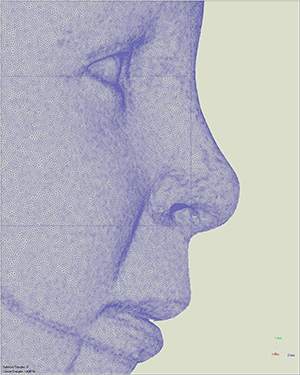
1) After scanning, the captured data is processed into a high-density polygonal mesh composed of millions of interconnected triangles that define the headform’s surface.
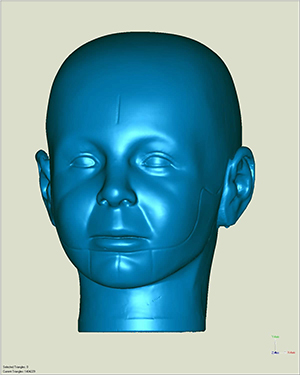
2) The mesh is rendered as a smooth, shaded surface for visualization and inspection, accurately representing the headform’s geometry, though not yet optimized for CAD design.
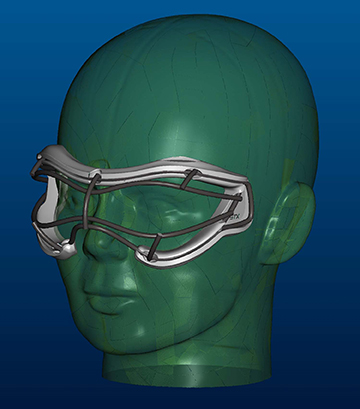
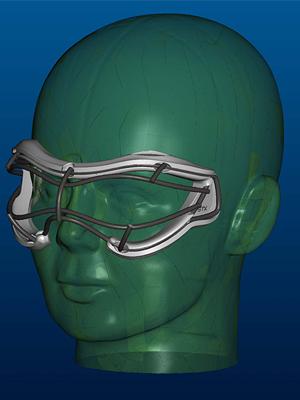
3) Using the CAD-ready surface model, designers developed the final eyewear geometry, precisely aligned to the scanned headform to ensure proper fit and performance.